Y·N
Living with 7 vampiresY/N is the sixteen-year-old girl at the center of the narrative, and her importance lies in the collision between a neglected human identity and a concealed supernatural inheritance. The story repeatedly places her body, memory, and name under the control of other people, yet it gradually gives her the means to choose, resist, and act. Her trajectory begins with abandonment and fear, passes through blood, mirrors, captivity, and identity crises, and culminates in a power she can wield against Gehan and the forces that claim ownership of her origin.
Identity and Abandonment
Y/N is introduced as a sixteen-year-old girl. Her first defining circumstance is not a stable home but a violent separation from it: her mother tells her to leave the car, promises to come outside, and then drives away quickly. Y/N watches the car disappear and cries out for her mother to return, making abandonment the first decisive event in her formation as a character. She is not merely lost in a physical landscape; she is abruptly deprived of the parental protection on which her understanding of herself depends.
Seeking shelter from the rain, Y/N reaches Vampire Castle and explains to RM that her parents abandoned her in the woods before she came upon the castle. She enters as an outsider who needs safety, but she soon remembers that the inhabitants are vampires and becomes frightened. This contradiction governs her early role: the place that offers refuge is also the place where she is most exposed to danger. Her arrival therefore functions as both rescue and threshold crossing, moving her from an ordinary human life into a supernatural conflict she does not yet understand.
Exposure to Violence and the Loss of Trust
Y/N’s vulnerability is made physical when a vampire drinks her blood. She feels lips against her collarbone, then a sharp pain, and realizes that he is feeding on her while another hand covers her mouth. The scene transforms the apparently intimate language of trust into an experience of coercion. Her fear is intensified by the fact that she had believed she could trust him. Blood is consequently not only a supernatural resource in Y/N’s story; it is the medium through which other characters define her value and attempt to control her.
V describes Y/N as the only blood vessel present, while Y/N rejects that label and insists that she is not a blood vessel. The exchange exposes the reduction imposed on her by the castle’s inhabitants. She is treated as a supply of blood before she is treated as a person, and her protest marks an early attempt to preserve a distinction between her body and the use others want to make of it. The later plot repeatedly returns to that struggle through feeding, poisoning, imprisonment, and supernatural transformation.
Y/N’s adopted family also becomes a source of traumatic revelation. When she returns to the house, she finds her mother lying on the ground in a pool of blood and takes her head in her hands. The discovery links familial love with death and violence rather than safety. Soon afterward, she learns that a baby had been found wrapped in a blanket with the name Y/N sewn into it, and she asks whether this means she is not her mother’s daughter, who her real parents are, and why they abandoned her. Her name thus becomes evidence of a hidden history: it is not simply a personal designation but a clue connecting infancy, adoption, and the unanswered motives of her parents.
Thresholds, Captivity, and the Search for Meaning
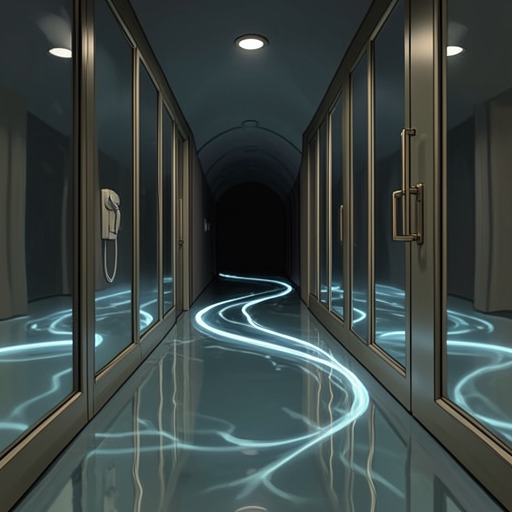
Y/N’s movement through the supernatural world is repeatedly represented as forced passage. When a shadow holds her wrist, it pulls her through a mirror whose surface feels like water, leaving her inside the mirror. An unknown figure welcomes her to a new world and throws her outside a bubble, while another danger immediately appears when an enormous water snake bites or attacks her leg with sharp pain. These episodes make the mirror a passage into peril rather than a controlled doorway. Y/N crosses boundaries without possessing the knowledge or authority to decide where she will emerge.
After the mirror ordeal, Y/N wakes in a hospital and asks where she is and what happened. RM asks whether she remembers, and she can recall only being in the mirror place. The exchange establishes a rupture in her memory as well as in her location. Y/N is conscious of a missing portion of her experience, so her search for identity must proceed through fragments, testimony, and confrontations rather than through a continuous account of her own past.
The story repeatedly places Y/N before figures who claim to know what she is. Mark asks what she will choose and why she is important, questions that force her to confront the possibility that her identity has a value beyond her role as a human blood source. In response to the danger surrounding the imprisoned companions, Y/N decides that saving them matters more than immediately learning who or what her parents are. She points toward the bubble, turning a mystery about personal origin into a moral choice. Her identity remains unresolved, but her priorities become clearer: she chooses action and rescue over passive possession of information.
Power, Resistance, and the Gehan Confrontation
Y/N’s most dramatic transformation occurs when she awakens within captivity. After her light and dark aspects call for the others to be saved, she opens her eyes while still chained and finds Gehan standing before her with blue fire in his hands. She says that she has had a conversation with herself, suggesting an internal confrontation or integration rather than a simple increase in physical strength. The change is immediately demonstrated when she moves her right arm and breaks the chain. Gehan appears afraid, and Y/N recognizes the reversal in their relationship by asking why he is afraid of his own daughter.
The confrontation confirms that Y/N’s connection to Gehan is not merely that of prisoner and captor. His fear reveals that her power threatens the authority he previously exercised over her, while her reference to being his daughter gives the conflict a familial and genealogical dimension. The revelation does not reconcile parenthood with care; instead, it makes inheritance inseparable from danger. Y/N must confront a parent whose relationship to her has been associated with control, secrecy, and the attempt to use her power.
Y/N then takes a glass ball from one of Gehan’s pockets and declares that she will keep it. She pushes him away and concentrates on making the gates of hell appear, producing a great rumbling. The action shows a new form of agency: she no longer merely escapes an imposed environment but alters the environment herself. The object she takes and the gates she summons connect her struggle to the larger supernatural architecture of the story, yet the immediate significance is personal and tactical. Y/N converts captivity into an opportunity to seize the means of resistance.
Her conflict with her mother continues even after this awakening. Suspended several meters above the ground and above her mother, Y/N is told to come down because she cannot control the power. Y/N answers by asking whether her mother wants to take the power away and make it her own, then compares her mother to her father. The accusation shows that Y/N now judges both parents through the same question: whether they regard her as a daughter or as a source of power. Her awakening therefore changes not only what she can do but also the terms on which she interprets family loyalty.
Relationships, Perspective, and Ending
Y/N’s relationship with the vampires is defined by an unstable mixture of danger, dependence, protection, and emotional attachment. J-Hope’s sudden appearance prompts her to ask what he is doing there and why she ran away, placing him in the position of someone connected to both her flight and her return. The vampires can shelter her, pursue her, feed on her, rescue her, or imprison her; their shifting functions prevent Y/N from assigning the castle a single meaning. Even while separated from them, she wonders how the others are doing and hopes they are better than she is. The narrative briefly shifts to the vampires’ point of view, where Jimin and V argue over a cookie, contrasting their ordinary quarrel with Y/N’s isolation and danger.
Y/N’s encounters with the green-eyed forces intensify her loss of control. Shadows stand behind her, and she recognizes the threat before Jin addresses her. Elsewhere, a shadow pulls her into the mirror, making pursuit and possession recur as the dominant forms of supernatural contact. Jackson’s approach to her throne-bound body, where he stops and bows, further frames her as the object of a ritual or political claim. These scenes surround Y/N with figures who watch, seize, address, or venerate her, while her own struggle consists in converting that imposed significance into self-directed action.
At the end of the supplied trajectory, Y/N wakes in the morning to the sound of her alarm and rises while still half asleep. The return to an ordinary waking routine sharply contrasts with the abandoned woods, the castle, the mirror world, the hospital, the chained chamber, and the gates of hell. It does not erase what happened; instead, it places supernatural trauma beside an apparently normal life. Y/N’s ending is therefore deliberately double: she can occupy the everyday identity of a sixteen-year-old girl while carrying the unresolved consequences of blood, adoption, parental secrecy, and awakened power.
Narrative Significance
Y/N’s arc is built from repeated transfers of agency. At first, her parents decide where she will be left, the vampires decide how her blood will be used, shadows decide where she will go, and captors decide whether she will remain inside a bubble, a mirror, or a chained chamber. Each transfer makes her body a contested territory. Her protests, choices, memory questions, and eventual destruction of the chain gradually interrupt that pattern.
The decisive change is not simply that Y/N becomes stronger. She begins by asking why she has been abandoned and whether she is truly her parents’ daughter; later, she chooses to save the imprisoned others even when her own origins remain unknown; finally, she breaks her chains, takes Gehan’s glass ball, summons the gates of hell, and challenges both parents’ claim over her power. The story thus makes identity an active achievement rather than a fact handed down by family or supernatural authority. Y/N remains surrounded by unanswered questions, but she is no longer only the person to whom the story happens. By the final confrontation, she has become the person capable of deciding what happens next.